Key takeaways
- Use current, representative photographs and video to show what a customer can actually expect at the location or service area.
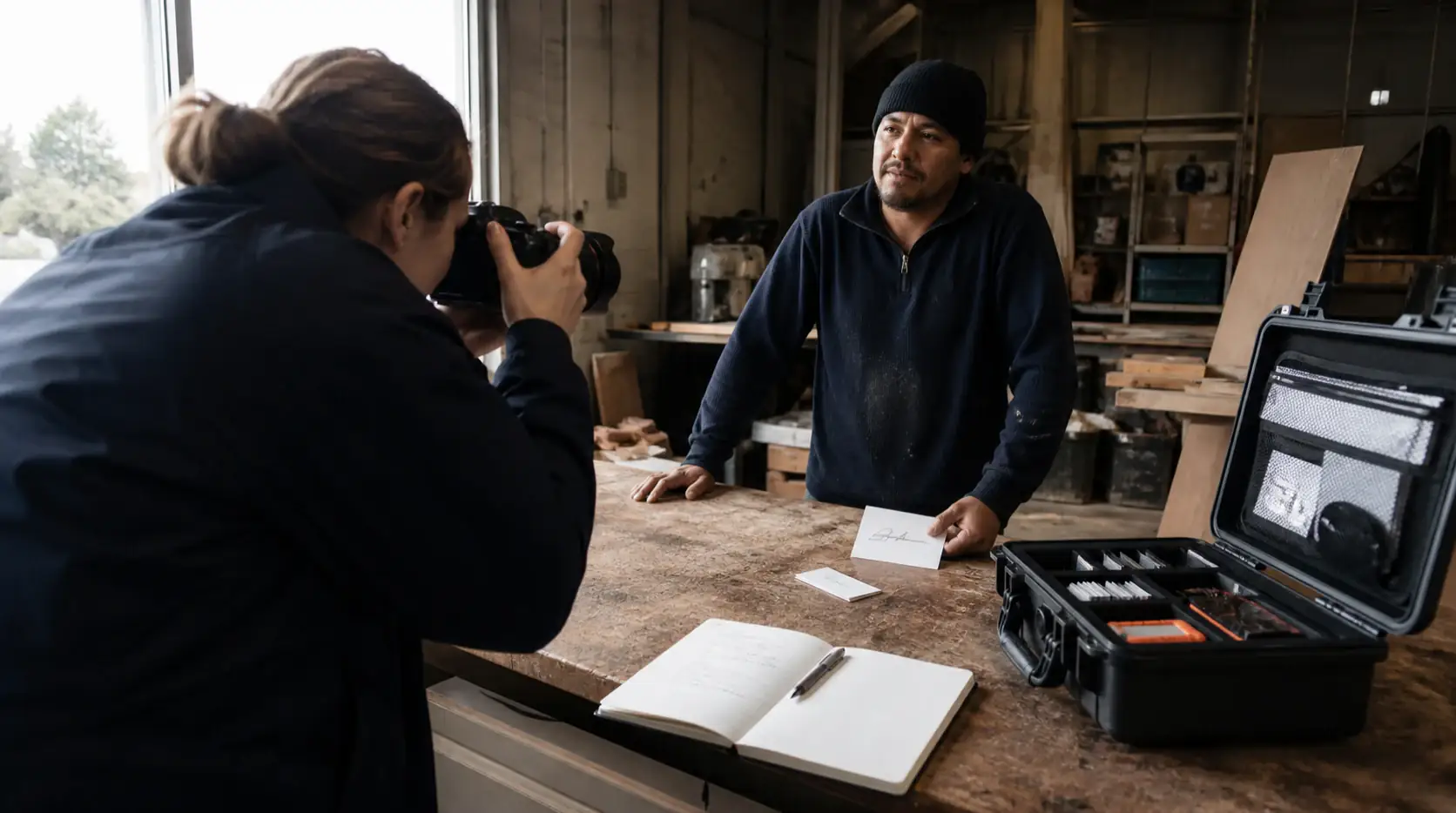
- Record creator, capture date, place, subject, rights, consent, edits, owner, approved uses, and retirement date.
- Protect faces, screens, plates, documents, homes, children, and other sensitive context before publishing.
- Never present an AI-generated storefront, team, customer, vehicle, office, or completed job as documentary evidence of the business.
01
The image answers a practical question before it decorates the page
A wheelchair user wants to see the entrance. A customer wants to recognize the service van. A parent wants to understand the waiting area. A buyer wants to know whether the workshop shown on the site is the place they will visit. A generic lifestyle image may be attractive and still fail every one of those jobs.
Write a shot list from customer uncertainty: exterior approach, entrance, parking or transit context, accessibility, reception, service environment, team roles, equipment, product scale, completed work with permission, and seasonal differences. Capture only what is safe and true, and explain material limitations in nearby text rather than asking the image to imply them.
Swipe to compare every column
| Asset record | Why it matters | Retire when |
|---|---|---|
| Location and capture date | Establishes context and freshness | Layout or signage materially changes |
| Creator, rights, and consent | Defines lawful, respectful use | Permission expires or is withdrawn |
| Subjects and sensitive details | Supports privacy review | Risk can no longer be controlled |
| Edit and publication history | Preserves provenance | Image becomes misleading |
02
Capture the permissions with the pixels
Assign each asset an ID and store creator, source file, capture date, location, depicted people or property, releases, licensing, allowed channels, crop restrictions, edits, alt text, caption, owner, and review date. A folder named “approved” cannot explain whether a former employee consented to a billboard or only an internal case study.
Review photographs for customer records, screens, whiteboards, badges, addresses, vehicle plates, children, medical context, homes, security controls, and bystanders. Blur or crop what is unnecessary. Keep an unmodified restricted original when the organization has a legitimate reason, and publish only the approved derivative.
03
Do not make synthetic scenery carry a documentary claim
Generated art can illustrate an abstract editorial idea when it is not likely to be mistaken for proof. It should not fabricate a storefront, office, employee, customer, product result, review, or local presence and present that scene as the business. The distinction belongs in the asset record and, when needed for understanding, in the visible context.
Google Maps policies prohibit misleading media and content that is not based on real experience. Search usefulness has the same human boundary: a polished fiction does not help someone find the correct door or decide whether a provider has done the work it claims.
04
Keep the media current and useful after launch
Serve appropriately sized, compressed formats, preserve a strong focal crop, and write alt text for the information the image contributes. Do not stuff location keywords into alt text. Captions can explain the date, place, process, or limitation when that context helps the reader.
Review assets when a location moves, signage changes, staff leave, equipment changes, permission expires, or a service is retired. Track missing rights, overdue reviews, inaccessible images, broken crops, stale documentary claims, and replacement coverage. A trustworthy library is smaller than a dumping ground and far more useful.
Primary sources and further reading
Use the source material to validate details against your own context and current platform configuration.
- Google Maps: Content policies
- Google Maps: How Google uses submitted content
- Google Search Central: Image SEO best practices
This field note follows the XenGrowth editorial policy: primary sources where available, visible limitations, material review dates, and no invented first-hand experience.
Stay with the problem