Key takeaways
- Roofing demand is lumpy. A hailstorm or hurricane creates a short surge of urgent, claim-related searches on top of a steady base of planned replacements.
- Storm searchers are often being solicited by door knockers and scammers at the same time, so verifiable licensing, insurance and local presence carry real weight.
- Never tell a homeowner what their insurer will cover. Explain the process and let the insurer and policy decide.
- Photo documentation is your strongest proof: dated, real, from the job, with permission, and with no misleading before-and-after claims.
- Roofing jobs are high value and slow to decide, so measure leads through to signed work, not only enquiries.
01
What makes SEO for roofing companies different from other trades?
SEO for roofing companies is project-based and event-driven. A roof is replaced once in a decade or two, so most customers are searching for the first time, with little brand knowledge and high stakes. Demand arrives in two shapes: a steady stream of planned replacements and repairs, and sudden surges after hail, wind or hurricanes when thousands of nearby roofs are damaged on the same day.
That changes the plan. You cannot build authority after the storm hits. The pages, profile, reviews and photographs that win storm-season searches need to exist beforehand, and the phone and quoting process must cope with the spike. A roofer who ranks and then takes five days to return calls will lose the work to whoever answered on day one.
02
How do storm and insurance-claim searches work?
After severe weather, searches shift toward questions: whether hail damage is covered, how to file a claim, what a roof inspection involves, who can do a temporary repair. A page that answers those questions plainly can earn visibility, but it has to stay on the right side of what a roofer can say. Insurance coverage is decided by the policy and the insurer, not by the contractor.
The US Federal Trade Commission warns that after disasters homeowners should not rely on a contractor to tell them what is covered, and should never sign an insurance cheque over to a contractor. The National Association of Insurance Commissioners separately cautions about assignment of benefits, an agreement that lets a roofer file the claim, make repair decisions and collect insurance payments without the homeowner's involvement. Your content should echo that stance: describe the steps, point to the insurer, and say what documentation you will provide.
- Explain how an inspection works and what the written report will contain
- Describe your temporary-repair (tarping) service separately from full replacement
- Say plainly that coverage decisions belong to the insurer, and that you will supply photos and an itemised estimate
- Avoid phrases such as "we will get your roof paid for by insurance" or "free roof"
- State your payment terms and never ask a customer to sign over an insurance payment
03
How do licensing and insurance shape roofing content?
Contractor licensing for roofing varies widely. Some states require a roofing or general contractor licence, some regulate at county or city level, and some have registration rather than licensing. Requirements for advertising, such as displaying a licence number, also differ. Confirm with your state contractor board or a local adviser, and then show the number, your general liability and workers' compensation coverage, and any manufacturer certifications you actually hold on a dedicated page and in the footer.
The FTC lists "claims they do not need to be licensed" among the red flags of post-disaster scams, which means your licensing detail is not decoration. It is the line between you and the out-of-town crews who arrive after a storm. If you use "local" in your copy, it needs to be true: a real address or area, a history that can be checked, and a profile consistent with Google's guidelines on how businesses may represent themselves.
04
What page types and photo proof should a roofer publish?
Build pages around decisions rather than keywords. Homeowners compare materials (asphalt, metal, tile), repair against replacement, and one contractor against another. Separate pages for each material and for repair versus replacement give each query a precise answer, and a page per service area gives context where you truly work and have completed jobs. Do not create near-identical city pages for places you do not serve.
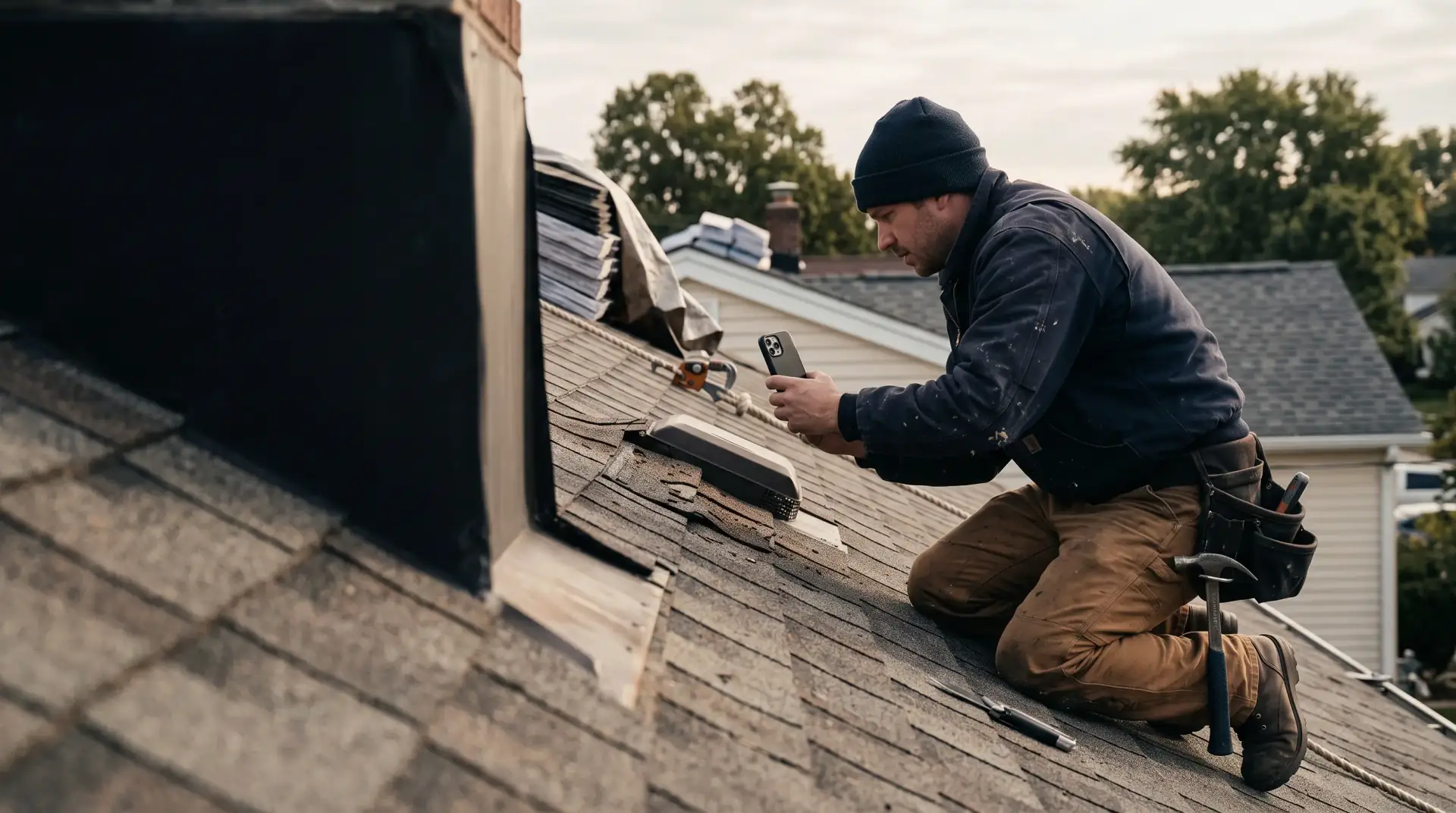
Photos are the most persuasive asset you have, and the easiest to misuse. Use images from your own jobs, with the owner's permission, taken in sequence: the damage, the work in progress, the finished roof. Describe what was done and, if you give cost, say it is an example for that house. Alt text should describe the scene. Never reuse another company's photographs or present a stock image as a customer job. Upload the same real images to your Business Profile so the proof appears where people choose.
| Page | Question it answers | Proof to include |
|---|---|---|
| Roof replacement | What does a full replacement involve and how is it quoted? | Process steps, warranty terms, licence and insurance, finished-job photos |
| Roof repair | Can this be fixed without replacing the roof? | Typical repair causes, how you assess, repair photos |
| Storm damage inspection | How do I know if my roof was damaged, and what happens next? | Inspection checklist, sample report, insurer-neutral wording |
| Materials (shingle, metal) | Which material suits my house and budget? | Honest trade-offs; completed examples of each |
| Service area | Do you work in my town? | Real completed jobs and reviews from that area |
05
How do reviews and the Business Profile work for roofers?
Reviews carry extra weight in roofing because the purchase is large and the trade has a reputation problem. Ask at completion, when the homeowner has just seen the clean-up and the finished roof, and give them a direct link. Do not offer discounts or gifts in exchange for reviews; Google's policies prohibit that, and the FTC's rule on consumer reviews bans fake reviews and review suppression through threats or intimidation. Respond to critical reviews with facts and an offer to resolve, not with a defensive rebuttal.
Set up your Business Profile as a service-area business if you do not meet customers at your premises, choose "Roofing contractor" as the primary category, and list services such as repair, replacement and inspection. Keep the area list honest, since profiles that misrepresent location risk suspension. After a storm, update special hours or add a post about inspection availability rather than leaving stale information.
06
How should a roofing company measure results?
Because the sales cycle can run from days (emergency repair) to months (planned replacement), track each lead by type: emergency, claim-related, planned. Record whether an estimate was sent, whether it was accepted and the job value. A CRM or even a disciplined spreadsheet is enough to see which pages and profile actions lead to signed work.
Look at seasonality honestly. A spike after a storm tells you about the weather, not about your SEO. Compare the same period in earlier years where you have data, and judge SEO by whether your share of local leads improved once the surge passed. For storm season, prepare in advance a call-handling plan, a quoting backlog process and a short script that stays within what you can say about insurance.
Was this useful? Send it to someone who owns this problem.
Primary sources and further reading
Use the source material to validate details against your own context and current platform configuration.
- FTC Consumer Advice: How to avoid scams after weather emergencies and natural disasters
- NAIC: Assignment of benefits, consumer beware
- Google Business Profile: Guidelines for representing your business
- Google Business Profile: Manage service areas
- Google Business Profile Help: Read and reply to reviews
- FTC: Consumer reviews and testimonials rule, questions and answers
This field note follows the XenGrowth editorial policy: primary sources where available, visible limitations, material review dates, and no invented first-hand experience.
Stay with the problem
Related field notes
 Local Search OptimizationReview Management Is a Workflow, Not a Reply Button: Ask, Route, Reply, Escalate, Use
 AI and answer enginesAI Search Optimization: What Moves Citations and What Is Folklore
 SEO & GEOTopical Map: Build a Cluster Plan Search and AI Can Read, and Know What Topical Authority Is Not